
Washington Busted Mugshots Explained
Booking begins when a jail logs a person and the reason for confinement. Staff photograph them for identification. The photo and the record are not equal under Washington law. The jail keeps a public register. It holds a short list of custody facts. Other records of a confined person stay confidential unless the law permits a use. The Washington Supreme Court applied that rule to booking photos in Cowles Publishing Co. v. Spokane Police Department. Release from custody does not open the photo.
Two systems cover two different moments in a case. County and city jails record local custody. A person there may be released, transferred, or moved to another facility. The Washington State Department of Corrections (DOC) runs prison custody and supervision. Its search is not a statewide copy of county arrests. A name can sit in one system and not the other. Each answers a different question.
Read the record with care. Charges can shift as a case moves forward. Confirm the outcome with the court that handled it.
The Washington Legislature page for RCW 70.48.100 shows the statute itself. It splits the public register from other jail records. Those other records stay confidential under the same section.
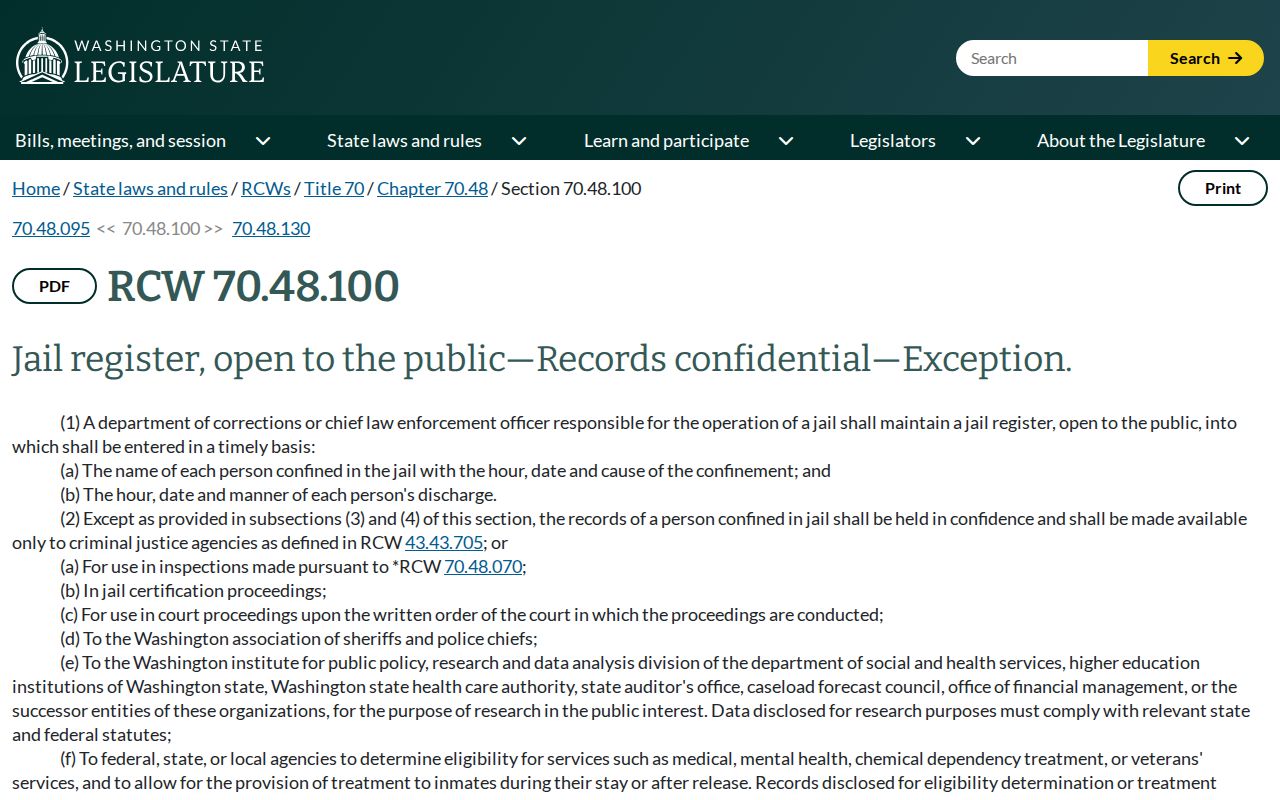
That same text explains why a public jail register never promises a downloadable booking photo.
Washington Busted Photo Rules
RCW 70.48.100 requires every jail operator to keep an open register. The register lists a confined person's name. Confinement entries show the hour, date, and cause. Discharge entries add the date and manner. All other records of a confined person stay confidential. Release is allowed only for a listed purpose. Law enforcement may use booking photos in investigations. The public holds no general right to download or republish them.
The Public Records Act sets the general rule for agencies. They must disclose unless an exemption applies, redacting protected parts where possible. The Cowles ruling placed booking photos under the jail-record rule. Release alone never makes a photo public. Washington has no pay-to-remove statute, so publisher opt-out policies are not a legal remedy.
Public register does not mean public photo. Request the two items separately. If an agency withholds an image, check the cited legal basis and the review route that applies.
Juvenile records follow separate confidentiality and sealing rules. Adults seeking conviction vacation face eligibility limits and waiting periods. A court order corrects the official record. Private copies do not vanish on their own. The fuller Washington-law picture, including publisher opt-out policies, sits on Mugshot Access Laws. Why might a record show no booking photo? One part is public, the rest can stay closed. A missing image says nothing about how the jail handled booking.
Washington Booking Record Fields
Washington has no single booking screen or statewide record layout. The statutory fields are the baseline. Counties add their own display choices locally. Those extras are not guaranteed statewide, and a release entry marks a custody event rather than a court outcome.
| Field or item | What it shows | Scope |
|---|---|---|
| Person's name | The name entered in the jail register | Required register field |
| Confinement time and date | When custody began | Required register field |
| Cause of confinement | The stated reason for confinement | Required register field |
| Discharge time and date | When the person left that custody | Required register field |
| Manner of discharge | How the custody ended or changed | Required register field |
| Charges, bond, court link, or housing | Local systems may show extra details | Varies by county and interface |
| Booking photograph | An image used for identification or investigation | Not a general public register field |
| DOC number, age, location, housing | State-custody locator details | DOC search result fields |
| DOC profile photograph | The public current incarcerated search inspected for this research showed no photo field | Not shown in that public search |
Whatcom County shows how local the choices get. Its official roster searches by name. Results carry booking date, facility, floor, cell, and a name number. Separate pages list bookings and releases by date. Those are interface choices, not statewide requirements. The public DOC search narrows things differently. It covers people currently in state facilities. Each entry shows a DOC number, name, age, location, and housing assignment. DOC policy photographs people at intake, including frontal and side views. Those images do not surface in the public incarcerated search. A separate DOC warrant page includes photos when available, but only for Secretary's warrants.
Requesting Washington Booking Records
Begin with the office that holds what you want. An incident report sits with the arresting agency. The jail register and custody record belong to the city or county lockup, and a regional or contract jail may hold someone arrested by a different county. Keep the request narrow and give a clear date range. Booking photos are a separate ask, since RCW 70.48.100 and Cowles treat the image differently from the open register.
County and city requests run through the Washington Public Records Act. Identify the likely custodian first. Under RCW 42.56.520, an agency gets five business days to respond. It can provide the record, acknowledge the request with a time estimate, seek clarification, or deny it with reasons. That deadline covers only the response. Production can take longer. And do not assume an image arrives with the register.
- Identify the county or city that booked the person and the facility that held them. The county directory routes to each county's local records path.
- Describe the record by name, approximate booking date, agency, incident or booking number if known, and record type. Ask for the jail-register entry, booking event, or release event as separate items.
- If seeking a photo, ask for it separately and request the legal basis for any withholding. Avoid broad demands for every booking photo or an entire jail file.
- Read the agency's response and estimate. If a record is denied or redacted, use the review process named by the agency or the Public Records Act.
DOC requests go to the DOC Public Records Officer. Put it in writing with your name, contact details, and the date. Describe the records precisely. A DOC number helps when known. Include the person's name, facility, date range, and record type. Ask for an intake image separately from a custody record. Staff may answer simple status questions without the formal process. A specific file or historical record will not. The DOC Public Records Request page spells out what to include.
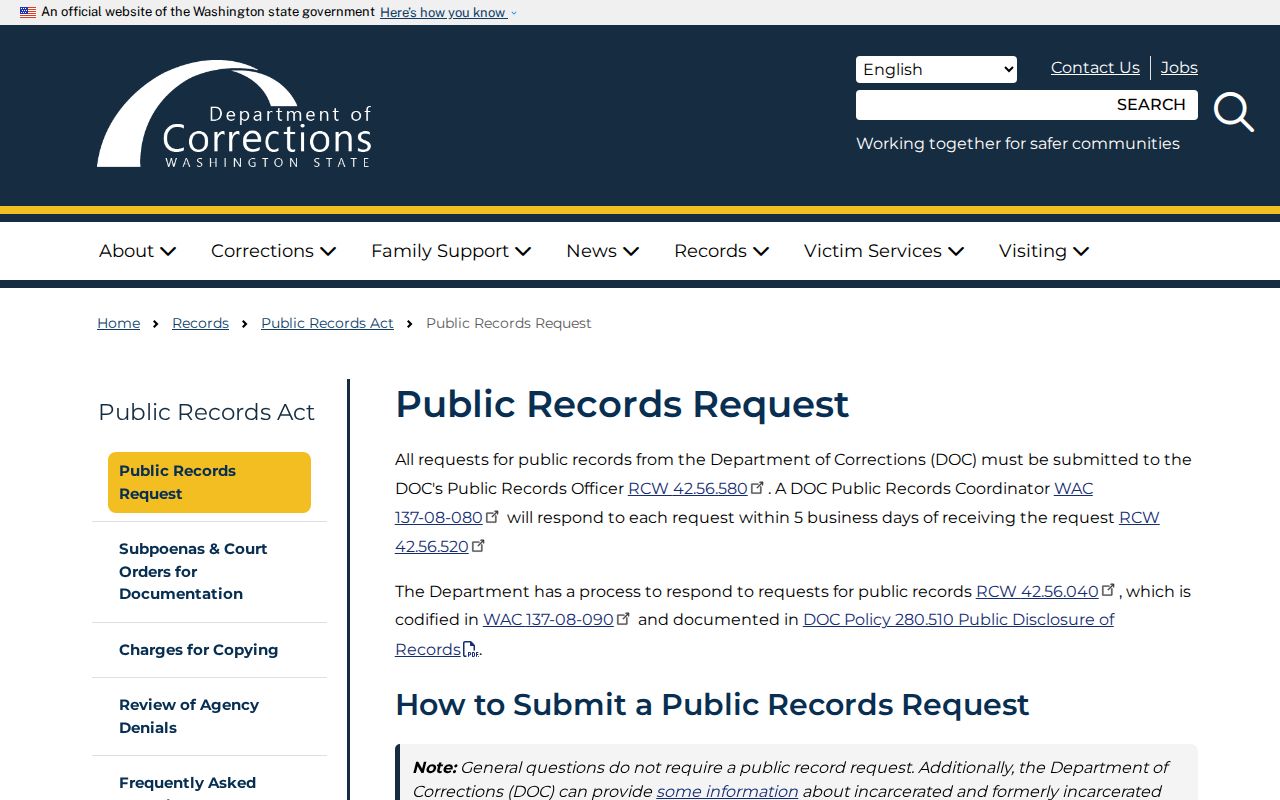
The DOC request page wants enough detail to locate the record, and it notes that disclosure still depends on exemptions and other law. The State Archives explains agency retention schedules and appraisal. Retention and access are separate questions. A record can exist yet stay confidential. It can also be destroyed or transferred on schedule. Court sealing, vacation, or WSP deletion can change official systems, yet an old image may survive on some outside publisher's site. Assume nothing vanished on its own.
Find Washington Busted Mugshots
Match the tool to the custody question. Someone just booked may appear on a county's current roster or a dated booking view. Release makes people vanish from current lists. The register or a dated entry may still exist. A prison sentence points to DOC's current incarcerated search, while a court docket answers what charge and disposition appear in the case.
- Start with the arresting agency or likely booking county. Check the county site for its official jail roster, booking view, or records-request page.
- Read the source label and date. A current roster shows custody at that facility, while a release view or dated booking page may show past events.
- If the person is serving a state prison term, search the DOC incarcerated locator by name or DOC number. Do not expect a photo in its standard public results.
- Use the official court search to check case events and disposition. The statewide name index is reference material; the court of record holds the official file.
- If the online view is missing or too narrow, send a defined request to the custodian. For federal prison custody use the BOP locator; for current immigration detention use ICE's locator and its required identifying fields.
A dead-end search proves little. The person may have been released. Booking may have happened in another county, under another agency, or under a different name, and a legal limit can also keep someone off a list. Confirm urgent custody questions with the agency itself. Skip the third-party repost. Does an empty county roster mean there was no booking? No, since many rosters track current custody only, and a release, transfer, or booking delay drops a person from that view.
Busted Across Washington Counties
Washington's 39 counties share no single arrest portal. Each one keeps its own records custodian. The local mix might include a roster, an app, a vendor inquiry, a PDF, a dated document, or a regional receiving jail. Columbia County's sheriff points readers to Walla Walla Corrections because Columbia bookings run through that regional route, so the custody record may sit with an operator far from the arresting agency.
Pick the arrest county in the Washington County Directory. The county page is the next stop for the local roster, feed limits, and records request. City arrests complicate this. They often pass through county or regional custody. The city name alone won't find the jail.
Busted Mugshots and County Feeds
Counties publish several kinds of official interfaces, but no single state feed. A browser roster may list current inmates. A bookings page can preserve dated entries. Some counties point users to an app or a vendor. Others post a daily file with no name-search box. Whatever the format, the source's own date and scope matter more than the word "recent" on a search result.
Whatcom County runs another model. Roster, bookings, and releases sit in separate views. The county says its dated bookings and releases reach back to 1996. The current roster shows no booking photo. Island County refreshes its roster every three hours, by its own statement. That view lacks a photo field too. These gaps are why no same-day feed can be assumed statewide. The Whatcom County roster is an official example of a searchable current-custody view with local housing fields.
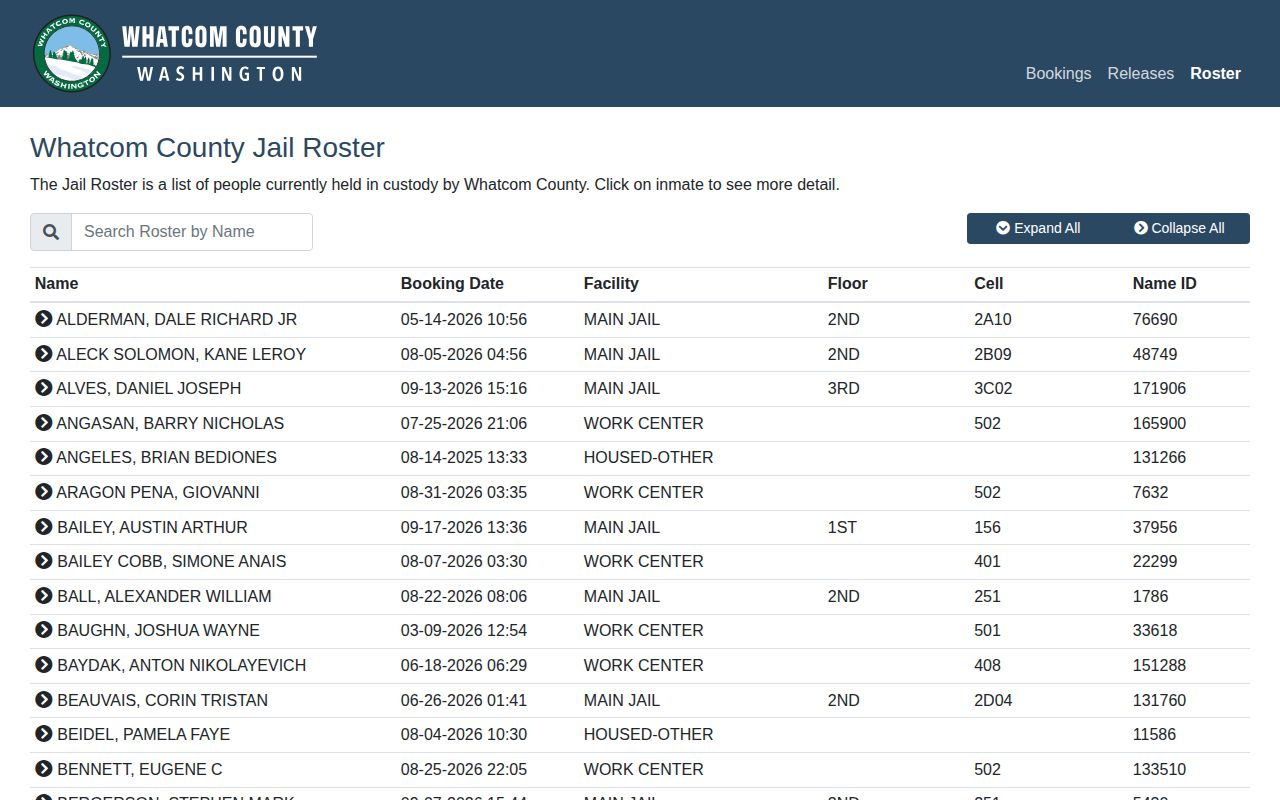
Whatcom's roster screenshot offers a name search. Local housing fields appear alongside, and the dated booking and release pages serve a different purpose than current custody.
| Example search field | What the interface shows | What it does not prove |
|---|---|---|
| Name | Whatcom's roster offers a name search | A no-result is not proof of no arrest |
| Booking date | Shown in the Whatcom roster and dated booking views | It is not a statewide booking window |
| Facility, floor, cell, name number | Local custody details in the Whatcom roster | These fields are not universal |
| Release date or release view | Available in some county systems | It does not supply a court disposition |
A custody page is not an arrest log. Keep that distinction in mind. Whatcom County promises no fixed refresh interval for its current-custody page. Pierce County's LINX roster leaves out anyone already released. It posts no numeric refresh schedule. Nor does the county run a separate 24-hour, 48-hour, or multi-day arrest feed. Puyallup's city jail keeps its own roster, bookings, and releases views. That tool has no fixed rolling window either. Read the date printed on the page. When the period you need is missing, ask the jail for a defined record.
Rural offices work differently. Pend Oreille County's Daily Press materials carry a date, but the county promises no upload time and no rolling 24-hour window. A weekly aggregate number is not a named log. San Juan County has no verified official same-day or multi-day booking feed. Its sheriff news archive cannot serve as a complete roster, and Columbia County likewise lacks a county-filtered same-day feed; Walla Walla's current and historical roster links carry a documented 2026 system-transition caveat.
DOC Search and Warrant Photos
The DOC Incarcerated Search covers people held in Washington state prisons. Search by DOC number or by name. Results show the DOC number, name, age, location, and housing assignment. No profile-photo field appears on the public page. The tool is a state-prison locator. It is not a statewide county booking feed.
DOC also runs a Secretary's Warrant Search. It targets community-custody violation warrants, not ordinary local arrest warrants. That page allows searches by first name, last name, DOC number, crime, or county, and it says photos appear if available. Under the policy DOC describes, a warrant open more than 60 days may be listed publicly. Never contact a listed person; use DOC's tip route or call 911 in an emergency.
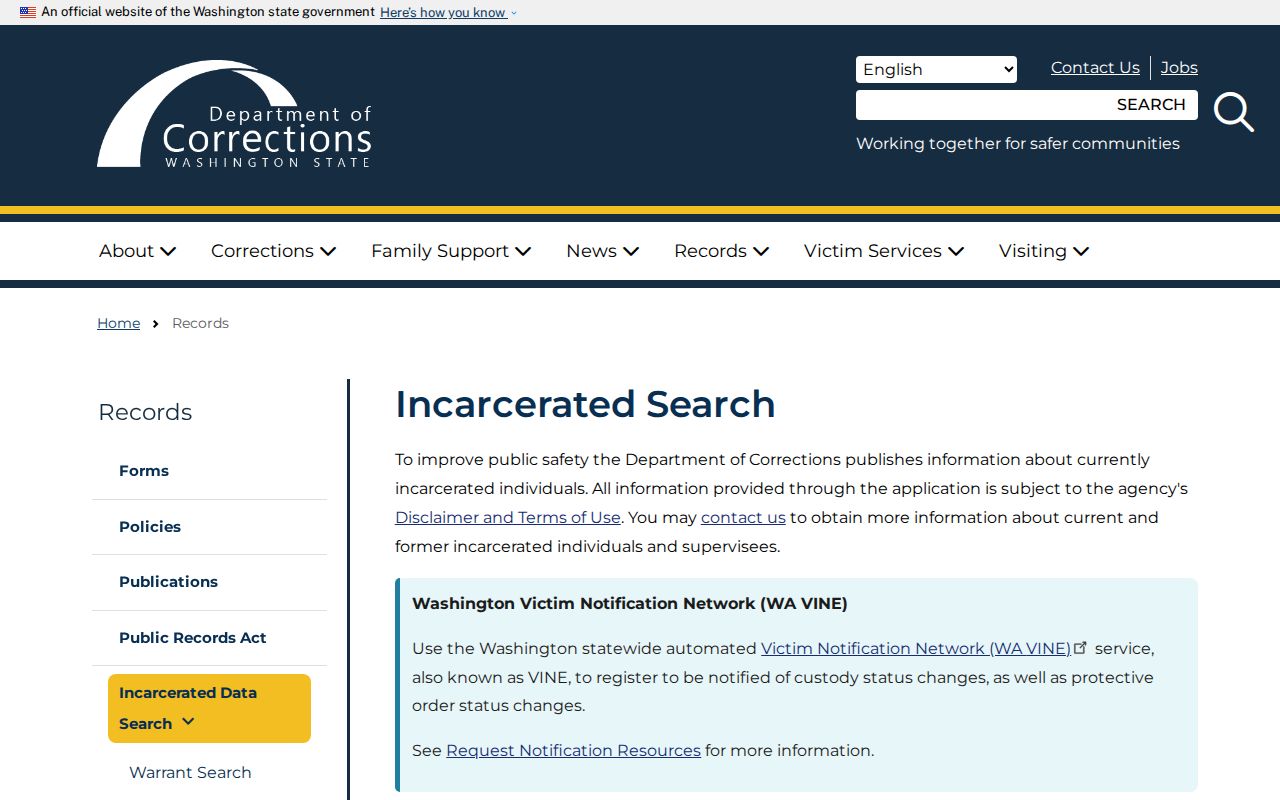
The standard search supports a current-custody lookup. It does not show that DOC publishes intake portraits; the separate DOC Secretary's Warrant Search states its own scope and photo notice.
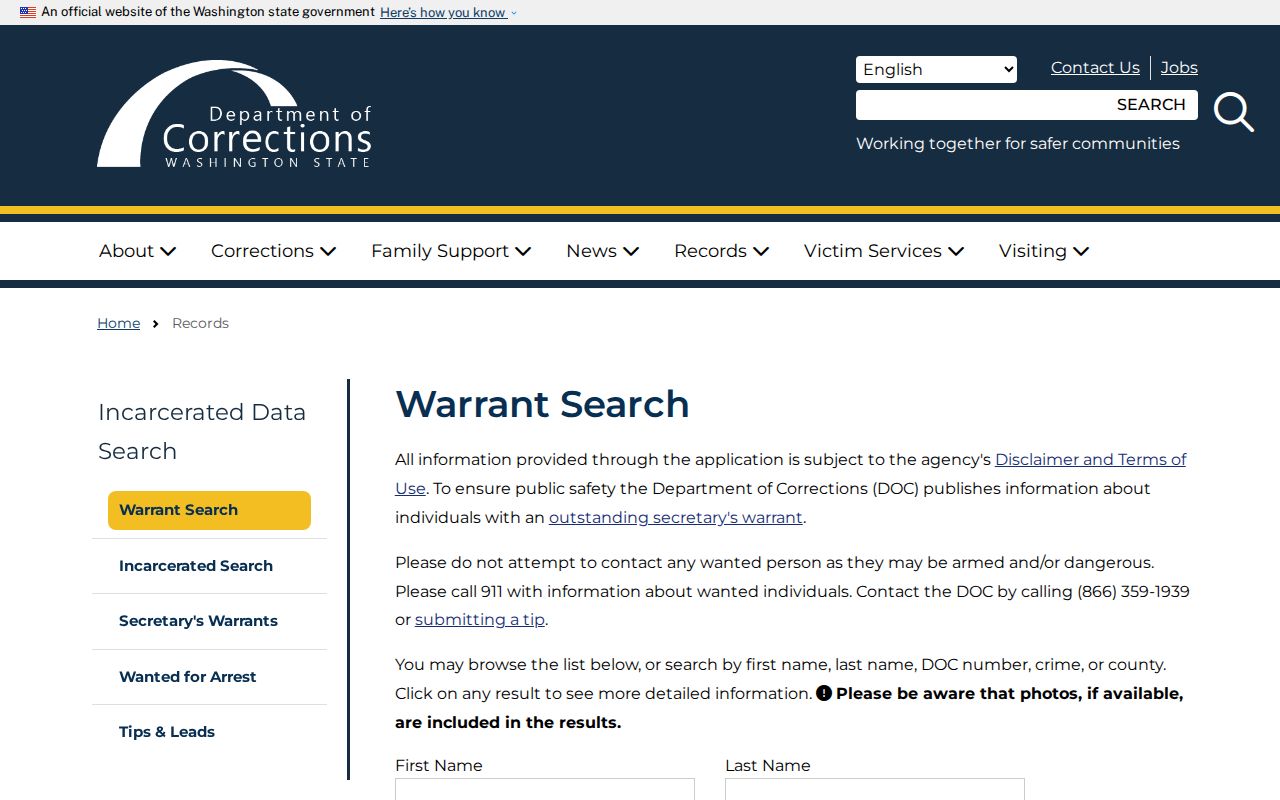
That photo notice belongs only to the warrant tool. It does not apply to the ordinary incarcerated search or to a county jail roster.
Washington Court and Federal Records
The Washington Courts name and case search can help you locate a docket. The court calls it reference information. It is not the official court record. The index updates daily, usually around 3 a.m. It does not contain every document. For a case file and final status, use the court of record or the clerk. Some participating superior courts also appear through the Odyssey Portal, while King and Pierce Counties use separate court tools.
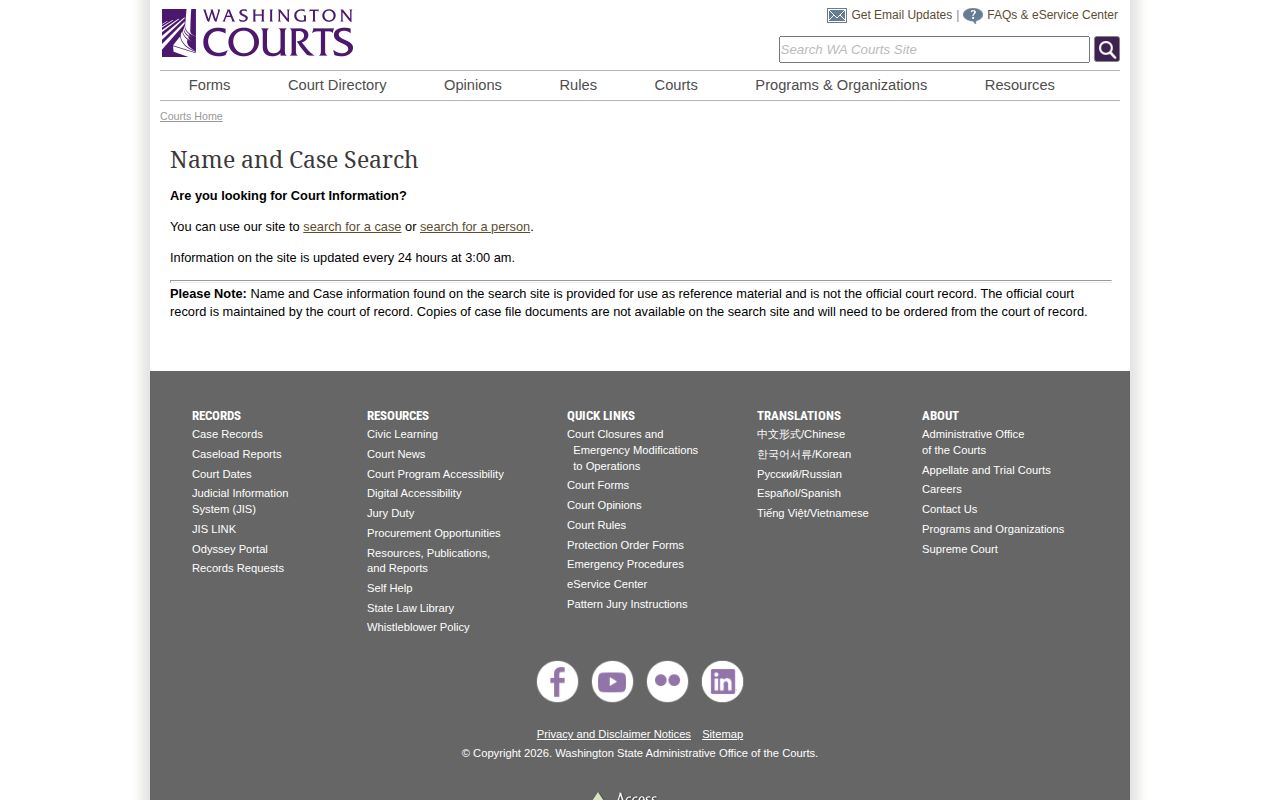
Confirm a docket entry with the court of record. That is the point of the reference notice.
The federal Bureau of Prisons locator covers federal inmates from 1982 forward. It lists name, register number, age, release date, and location. No public photo field exists. The ICE Online Detainee Locator covers people held by ICE or in qualifying CBP custody. Search by A-number and country of birth, or by exact name with required identity details. It has no public mugshot function and is not a local arrest list.
A case can outlast a jail stay. The roster records custody. It does not show whether a prosecutor filed charges, whether a charge changed, or how the court ruled. Those answers live in the relevant court record.
Where Washington Booking Records Appear
Match the source to the question. A wanted notice, jail register, court docket, and federal custody result do not report the same status. Washington's legal rule matters here. A photo on a site does not by itself prove the image came from an official public release.
| Channel | What it covers | Photo status | How to read it |
|---|---|---|---|
| County or city jail roster | Usually current custody at that facility | No statewide public-photo field; local policy varies | Check scope, date, and release view |
| Jail register or booking request | Confinement and discharge events | Other jail records, including photos, are generally confidential subject to exceptions | Ask separately for the register and any image |
| DOC incarcerated search | People currently incarcerated in state facilities | No photo field on the inspected public search | Not a county booking list |
| DOC Secretary's Warrant Search | Specified community-custody warrants | Photos may appear if available | Not a general county warrant database |
| Washington Courts search | Case names, events, and docket references | Not a booking-photo feed | Confirm the result with the court of record |
| BOP or ICE locator | Federal prison or current immigration detention | No public photo field | Different custody systems and legal status |
| News or mugshot publisher | Selected reporting or copied records | May show an image, but not as an official statewide record | Check the originating agency and court |
A released person may drop off a current roster. That does not make a booking photograph generally public in Washington. The register or a dated local booking entry may still exist. The image stays under the jail-record confidentiality rule. A state prison sentence moves a person into the DOC system, while a federal sentence belongs to BOP. Do not blend these paths into one arrest search.
Washington Busted Warrant Checks
A wanted list and an arrest warrant answer different questions. The Washington State Patrol Most Wanted page is a tip channel, nothing more. It does not track every open warrant in the state. The DOC's Secretary's Warrant Search has its own limits. It covers only people under its supervision. A bench warrant or arrest warrant issued by a county still lives with its court. That is the court that signed it. No single county list can speak for all of them.
Check a name through the official source first. Then call the issuing court or agency for status and next steps. Never approach or follow anyone shown on a wanted page. Names get reused, and photos run old. Details can be plain wrong. For the broader wanted-fugitive and warrant-check process, the Wanted Fugitives page holds the detail.
Secondary Washington Arrest Sources
Third-party arrest sites copy selectively, so none of them is a full record. The RecentlyBooked Washington index covers about 20 county sections out of 39. It says so itself. Its content is a publisher view, not a government feed. Mugshots.com runs a Washington index too. It holds county pages and older entries. Neither one counts as an official custody record. Any photo or status label there needs checking before it means anything. Check it against the jail, the agency, and the court.
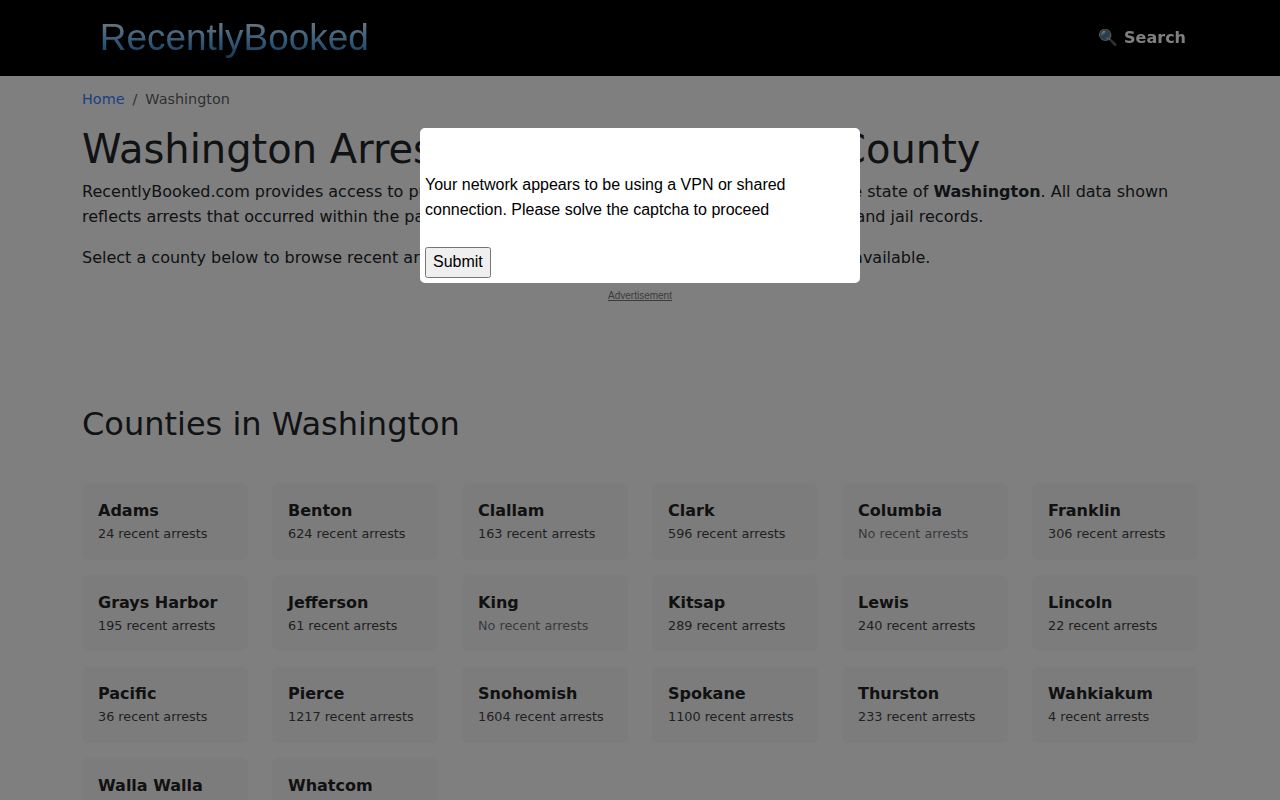
The index lists selected counties behind an access prompt. It is not a statewide roster. The publisher's Washington state index offers its own secondary search interface, nothing official.
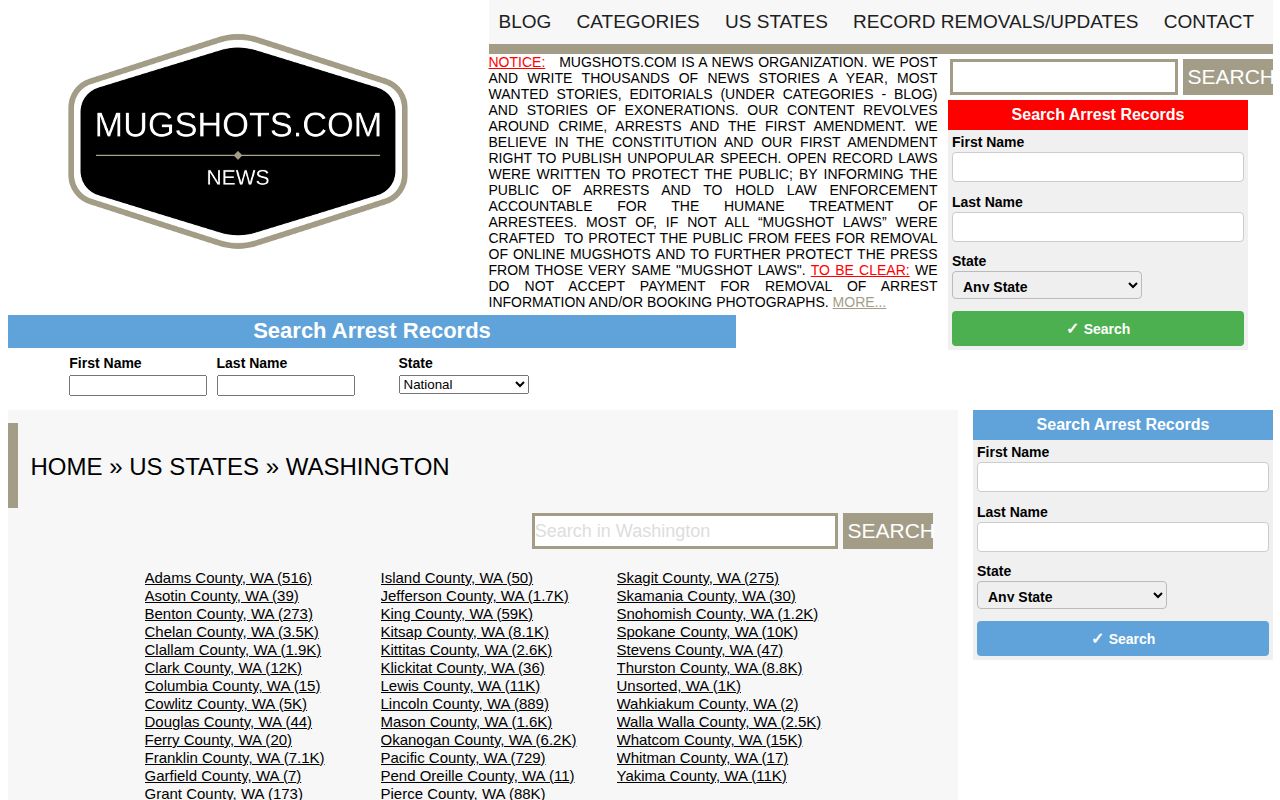
This is a private publisher's state index, not a Washington agency portal. No image from either publisher appears here as a person-result gallery. RecentlyBooked's policy makes qualifying correction or removal requests free. Mugshots.com's record-maintenance policy also waives fees for updates or removals. Documentation must back the request. Both are conditional private policies. They are not a state promise that every accurate entry comes down. A free request cannot by itself fix a false or outdated court label. Confirm the official disposition first. The Washington law page explains those limits and separates real correction from a search-result refresh.
Other secondary pages can be selective or unverified. A page labeled "recent arrests" may mix old entries, copied charges, and stale images. Local news picks individual stories. It may run an agency portrait, a file photo, or a courtroom sketch. None of that is the court's final word.
Washington Busted Mugshots: Older Records
Old booking material does not stay put. It can drift from a local agency's active system into a court archive. It can also land in a State Archives series. One Washington Archives series, "Inmate Custody Files, Notorious or Historically Significant Inmates," carries a six-year retention period after incarceration ends. Permanent transfer follows when it applies. That category is selective. Ordinary booking photos do not all become archival records. A historical admission portrait tells you nothing about current custody.
For a record that has aged out of a current roster, start by identifying the original jail, the court, and the approximate date. The Historical Mugshots page covers the state collections, retention schedules, and the archive request path. For newer entries, the county system remains the starting point.