
Are Washington Busted Mugshots Public?
RCW 70.48.100 splits jail records into two piles. One pile is the public register. City and county jails must keep it open. The Department of Corrections must do the same when it operates a facility. The register lists a confined person's name. It also records the time, date, and cause of confinement. The time, date, and manner of discharge appear there too. Those fields support a current-custody check or confirm a release. The booking image is not one of them. It sits in the second pile.
Other records about a confined person stay confidential under the same statute. Listed uses and exceptions apply. Law enforcement may use a booking photo to help an investigation. That clause allows use, not publication. It creates no public right to download or repost every image. A few narrow statutes permit specific disclosures, including some sex-offender information. A photo's lawful status therefore turns on its source. It also turns on the authority behind its release, not on the fact that a booking occurred.
| Open register field | What it records | What it does not prove |
|---|---|---|
| Name | The person confined in the jail. | That a charge ended in conviction. |
| Confinement time and date | When custody began. | That the person remains in custody now. |
| Cause of confinement | The stated basis for the jail entry. | The final court outcome. |
| Discharge time, date, and manner | When and how custody ended. | That the case itself is closed. |
The open-register rule explains why some rosters show names but no faces. Washington jails list custody events. Faces are another matter entirely. An online roster may display fewer fields than the statute's full register. A missing field invites a question to the custodian. It does not call for faith in a private repost. The current RCW text shows the register requirement and the confidentiality rule side by side. That pairing matters whenever someone asks whether a booking photo is public.
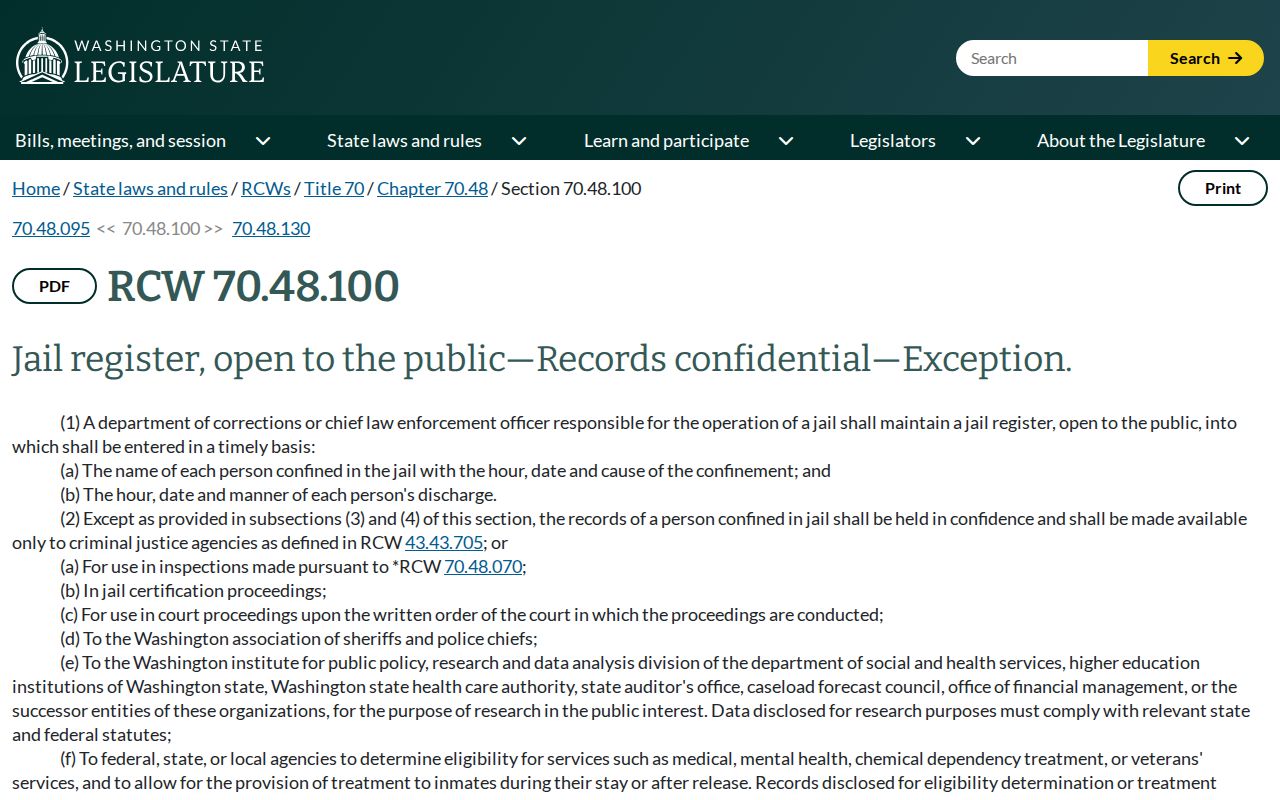
The official statute page makes the split plain. An open register can list custody facts without offering any public mugshot download.
Note: An open register entry documents confinement details at one point in time, not a person's guilt or present whereabouts.
Washington's Busted Mugshot Cases
The Washington Supreme Court drew the line in Cowles Publishing Co. v. Spokane Police Department. Booking photographs are confidential records under RCW 70.48.100(2). Release from jail changes nothing. A photo can remain part of a confidential jail record after the person walks free.
The Court of Appeals applied that reasoning in Zabala v. Okanogan County. The records there had moved between law-enforcement agencies. A new custodian does not erase the confidentiality rule. The lesson: name the record you seek. A jail-register request is not a demand for every photo in a booking system.
Lawmakers have also tested a broader policy. House Bill 1723 in 2015 would have made jail booking photographs and electronic images public. Senate Bill 5776 in 2017 proposed public DOC photos tied to Secretary's warrants. Neither bill passed. The statute still splits the open register from confidential confined-person records. And the investigative-use clause still covers only law enforcement.
Request a Washington Arrest Record
Washington's Public Records Act governs requests to state and local agencies, subject to exemptions. Under RCW 42.56.520, an agency has five business days to respond. It can provide the record or acknowledge the request with a reasonable estimate. It can also ask for clarification. Or it can deny the request with an explanation. That deadline covers the response only. Production of the actual records can take longer once the response deadline has passed. An agency may also redact protected material or withhold a record under an exemption.
A narrow request routes faster. A demand for all mugshots does not. Identify the likely custodian of the record and the event behind it. Then state the record you want. Ask for the jail-register entry, booking event, release event, or a nonexempt administrative record. Keep that request separate from the booking photograph. Give a date range and a case number if you have them.
- Choose the agency that made the arrest or operated the jail. The arresting police department, receiving jail, and court may be different custodians.
- Name the record type and event, such as a register entry, booking date, discharge record, or incident report.
- Include a useful date range and case or incident number. Avoid requesting unrelated people's records.
- Ask the public-records officer to identify the legal basis for any withholding or redaction.
- Track the response estimate and ask about the agency's review process if a denial cites an exemption you believe does not apply.
A photo request needs its own legal analysis. An agency may hold an image for identification or investigation while the jail register stays open. A refusal settles nothing about third-party sites. It does not vouch for their accuracy. Nor does it decide whether a separate court record, disposition, or release event can be disclosed.
When a Record Is Withheld
Juvenile records follow their own rules. Under RCW 13.50.050, the official juvenile court file stays open to the public unless a judge seals it. Most other juvenile records stay confidential. Information can leave the system only when the child and family cannot reasonably be identified from it. The statute reaches identifying data too, covering photographs and fingerprints kept in state criminal-history files. So an adult roster says nothing about a juvenile booking. A young person's name or image simply does not belong there.
RCW 13.50.260 handles sealing, including automatic administrative sealing in set circumstances. Timing hinges on age, supervision, release, and offense type. Serious violent, sex, and specified drug offenses get different treatment. Acquittals and dismissals with prejudice carry their own sealing rules. Rely on the court's process and order. Turning eighteen alone does not erase every record at every office.
Adults can seek deletion of qualifying nonconviction data from criminal-history files through RCW 10.97.060, once the statutory waiting periods pass. Exceptions exist. A pending case, fugitive status, or diversion can block the request. So can a prior qualifying conviction or an intervening arrest or charge. The State Patrol process touches criminal-history files only. It will not scrub every copy held by a jail, court, news archive, search engine, or private publisher. Keep the disposition order, and submit the supporting record the State Patrol requires.
"Nonconviction" names a category within criminal-history records, not a promise that public traces disappear. Dismissal, acquittal, diversion, a charge reduction, and a sealed court file are distinct outcomes. Ask the record custodian which file it holds and which rule governs that copy.
Note: A State Patrol deletion request affects qualifying criminal-history data, not each local, court, or publisher copy.
Sealing, Vacation, and Photo Limits
Sealing, deleting, and vacating are three different things. Washington Courts says so plainly in its own plain-language explanation. A court order shifts the legal status of the case records within its scope. That is the extent of it. Agencies and publishers that never received the order may still hold their own copies.
Misdemeanor and gross-misdemeanor convictions can be vacated under RCW 9.96.060. The applicant must check every box. The sentence must be complete. No charge can be pending. The waiting period must have run without a new crime. Certain offenses are excluded outright. For many eligible offenses the wait runs three years from the later qualifying date. Domestic-violence convictions carry a five-year period plus notice and treatment conditions. A judge must grant the request; it is never automatic.
Felony vacation works through RCW 9.94A.640 with offense-specific limits. Many violent, sex, person, and felony DUI crimes simply do not qualify. Class B convictions generally demand ten years with no new conviction. Class C generally demands five. Both clocks start at the applicable later date. Both face exclusions. Treat these as case-by-case thresholds rather than blanket rules for every matter. The statute and the court's order control what happens in any individual matter.
One more practical point. A favorable order may never reach a historical booking photo. It may sit outside the court or criminal-history system. Separate copies call for separate requests. Send them to the court, the original agency, the State Patrol, and any publisher. And use the right words. "Sealed," "vacated," "deletion requested," and "publisher update requested" each describe a different situation.
Removal Requests After a Busted Listing
Washington has no statute that bans a private publisher from charging to take down a booking photo. That gap is not a green light. Other laws still apply. A court order can forbid a use. So can privacy rights or limits on what an agency may disclose. A publisher's own policy creates no state right.
Mugshots.com takes one approach. Its Record Maintenance policy makes qualifying updates free. Expungements, seals, and identity-theft cases qualify. So does death. Send the publisher's record ID and legible documents with the request. The policy states a target time. It guarantees no result, and terms change. The Mugshots.com policy page spells out its documentation conditions.
RecentlyBooked also waives its fee for qualifying requests. Dismissed charges qualify. So do sealed records, wrong-person matches, and duplicate posts. Outdated details and juvenile records count too. Requests need the post URL, name, and arrest date. Include the location and a reason. An accurate, current public entry stays up regardless of the ask.
Neither company speaks for Washington government. Both are unofficial publishers. Their rules say nothing about lawful disclosure. Verify with the holding agency and court. No request erases copies saved elsewhere. Payment pressure is a warning sign, and paying never guarantees full removal.
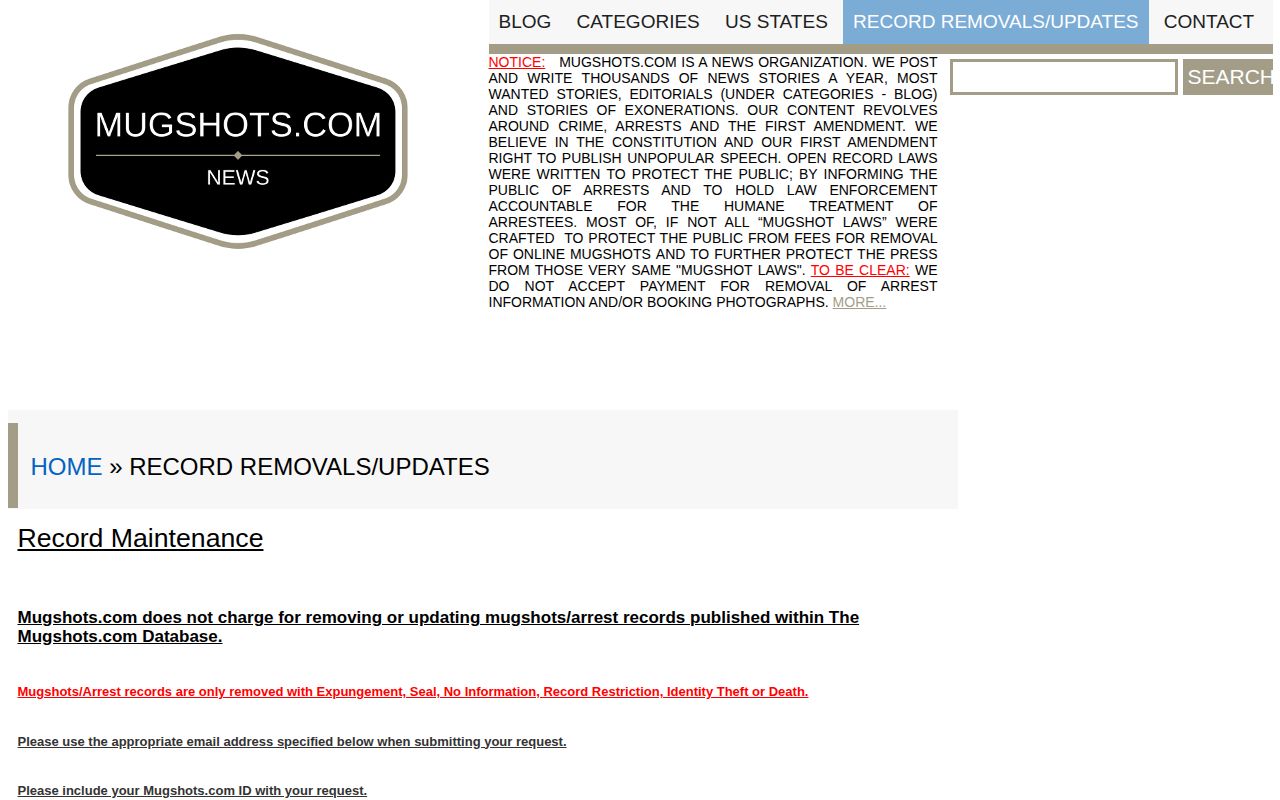
A busted listing does not come with a government eraser. RecentlyBooked's stated free policy offers only a conditional update route. It asks for specific records and details before anything changes on the site.
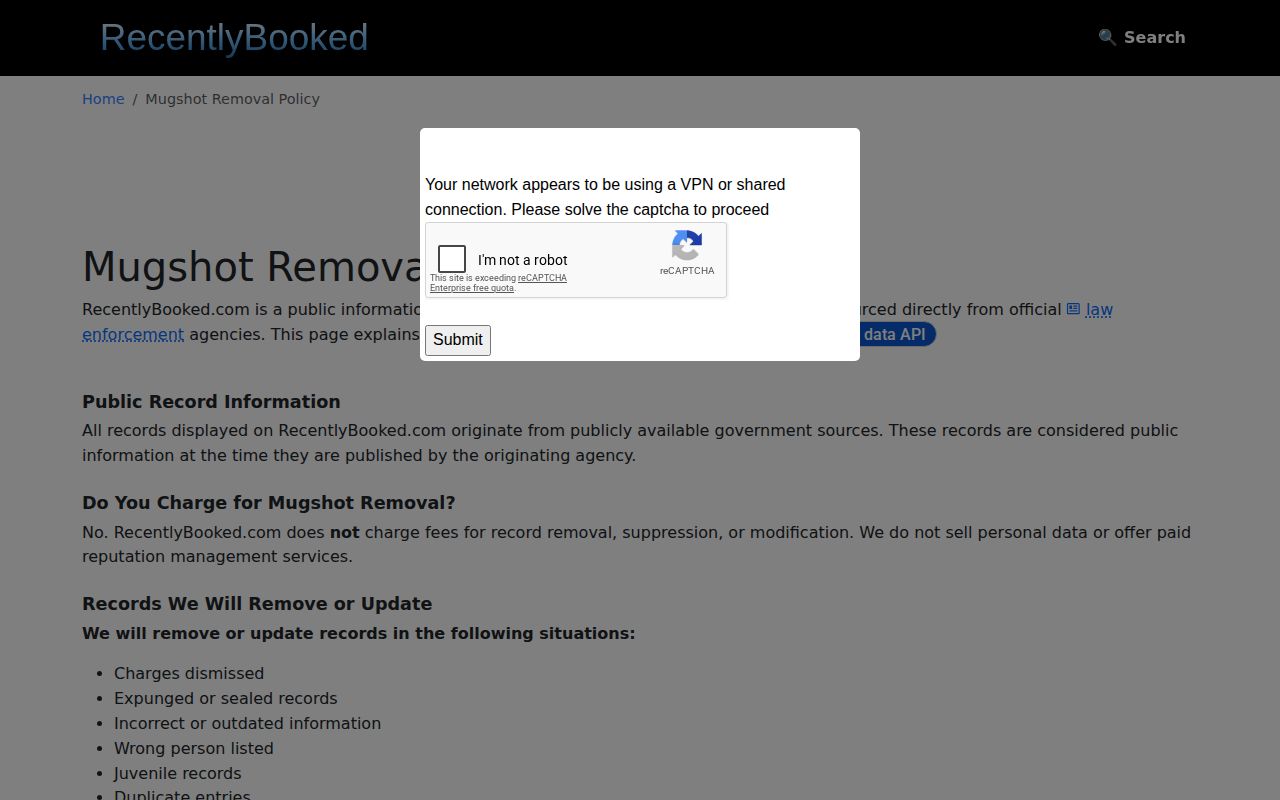
The policy's exact terms matter here. Check the publisher's page directly before relying on any removal route it describes.
Retention Rules for Busted Records
Retention and public availability are two different things. A jail register, a booking system, an investigation file, and a photograph can each sit on its own schedule. Each follows its own path. Exemptions can differ too, even while the records are still held. The Washington State Archives points agencies toward current retention schedules and archival appraisal categories. At the end of a schedule, a record faces three outcomes. It may be destroyed, moved into an archival series, or filed under a different record class. Not one of those outcomes turns every stored image into a public booking photo. One Washington schedule stands out. It keeps a permanent archival series for inmate custody files. The files must qualify as notorious or historically significant. That series can span admission, booking, transfer, classification, infraction, release, community-corrections, and court material. Transfer for permanent retention waits six years after incarceration ends. Appraisal weighs documented public and historical value. Examples include heavy media attention, a policy change, scholarly use, or institutional impact. The rule does not sweep every routine arrest file or photograph into the archive. The Archives retention page lists the law-enforcement schedule and the appraisal guidance agencies follow.
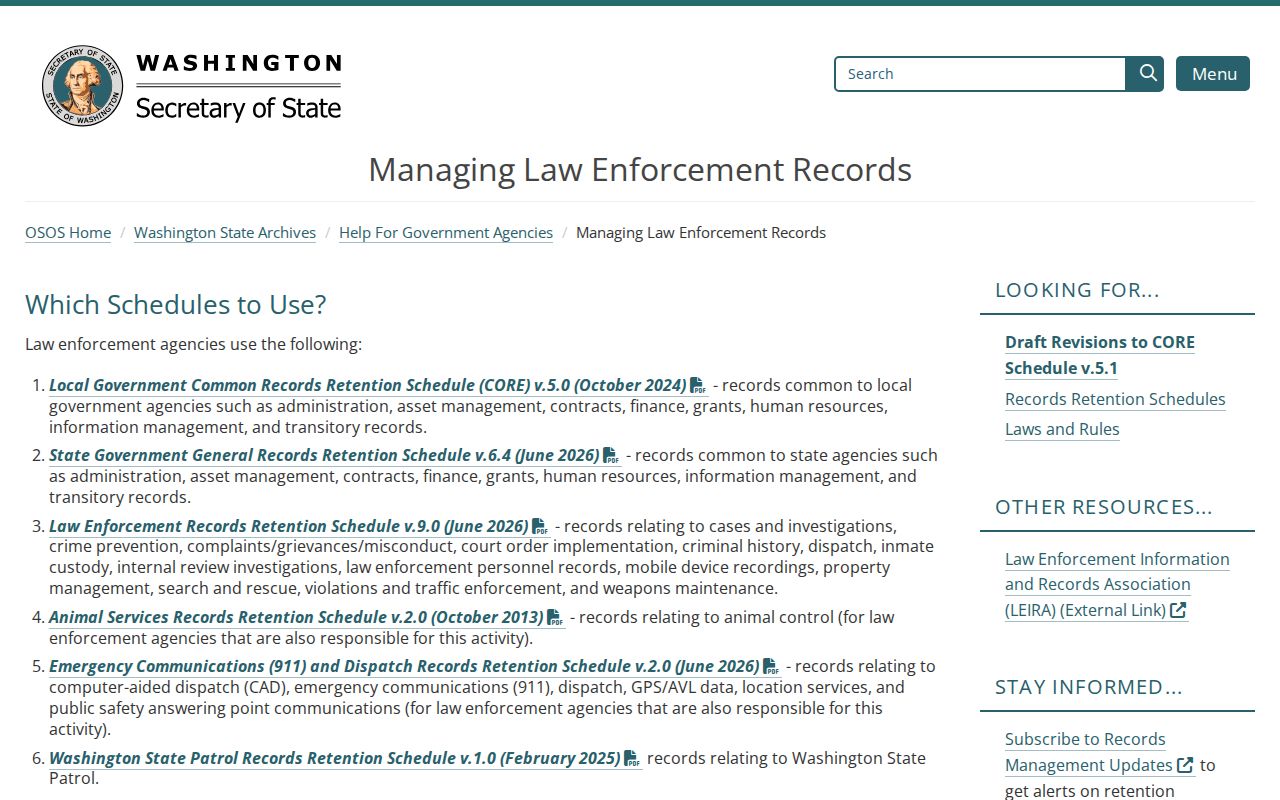
The schedule interface serves agencies, not the public. A transfer decision and an access decision remain separate steps. Note: Agencies apply their own retention schedules, and an Archives appraisal does not make every retained file public.
Washington Busted Mugshots: Verify Status
Tracking a Washington busted mugshot down takes a few steps. Begin with the local jail roster. County and city systems work differently, and the Washington arrest and roster overview sorts out those differences. It also covers what to do when a booking record lacks a register field. Asking the holding agency directly clears that up fast.
State sentences are a separate track. If the person landed in DOC custody, use the Department of Corrections search instead. It follows its own record rules. The Washington DOC mugshot and offender-search page walks through that custody layer and its quirks. Once charges move to court, a case index becomes the stronger tool. Treat a name search there as a starting point only. The clerk can confirm what the index shows.
Verify before you share anything. Match the agency, the date, and the custody status. Rosters lag behind reality. Someone booked an hour ago may be free before the list refreshes. A name that has dropped off can still mean a past booking event, so treat any roster entry as one clue rather than the whole story.