
How Washington Wanted Lists Work
No single public index gathers every active warrant in Washington. Each agency posts its own notices, shaped by its authority and safety needs. The Washington State Patrol (WSP) page seeks public tips. The Department of Corrections (DOC) warrant search covers people under community custody who may have violated release conditions. U.S. Marshals Service (USMS) notices track federal fugitives. County sheriff and police pages add local lists.
A wanted notice is not a booking record. It may reflect an outstanding warrant or a request for help. The person may already be arrested, cleared, or have a resolved case since the page was updated. Read the date and the instructions. Confirm current status with the issuing agency.
The Washington State Patrol Most Wanted page carries an explicit warning never to contact anyone shown. That safety framing suits a narrow tip request. It is not a statewide roster of all warrants. The presentation is narrow by design.
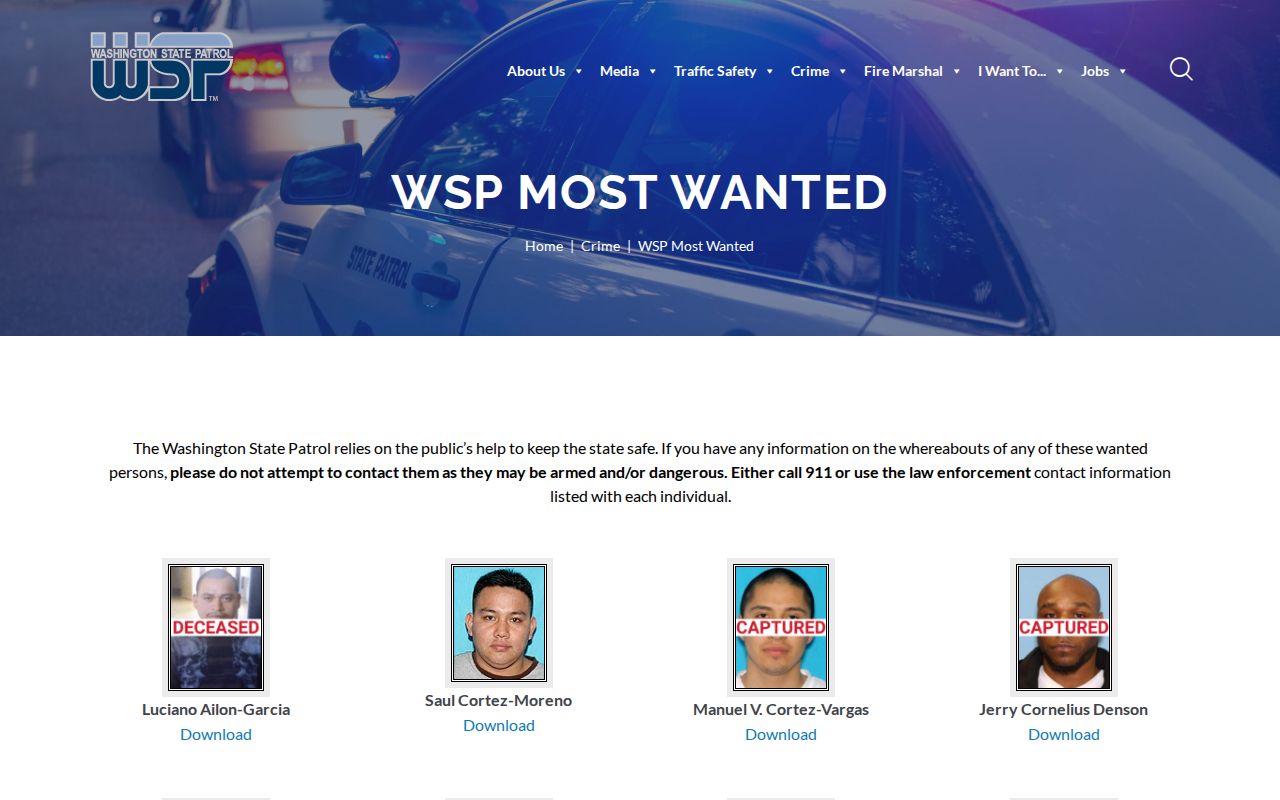
Use the official page for anything current. A static copy grows stale fast and can expose someone to mistaken identification. No names or faces are copied here.
Official Washington Wanted Sources
These sources are separate entry points, not one combined database. The list owner sets its scope, photos, updates, and tip route. Start with the agency named in the notice and follow its current instructions.
| List | Who runs it | Photo scope | Official page |
|---|---|---|---|
| Washington State Patrol Most Wanted | Washington State Patrol | Selected notices may show an image; use the live agency page. | WSP Most Wanted |
| Secretary's Warrant Search | Washington State DOC | DOC says photos may appear when available. | DOC warrant search |
| DOC wanted resources | Washington State DOC | Routes users to agency sources; coverage varies. | DOC wanted page |
| U.S. Marshals Most Wanted Fugitives | U.S. Marshals Service | Federal notices may include agency photographs. | USMS Most Wanted |
| County and city notices | Local sheriff or police department | Local policy and notice details differ. | Use the arresting or investigating agency's official site. |
USMS is a federal service, not a county database. Its district directory covers the Eastern and Western Districts of Washington. The national list may miss people either district wants. The DOC wanted landing page, likewise, points to several agencies rather than one combined warrant search.
County Lists Depend on the Agency
Sheriff and police departments often post their own wanted pages. Format and coverage vary widely. Some run named notices. Others push tips to a phone line or a regional task force. A county list only covers people that one office seeks. Treat it as a slice, not the county's full warrant set. The warrant holder may not be the arresting agency. The court handling the case can be a third, separate office.
Start with the county tied to the case. Follow links from its official sheriff or police website. The Washington county directory routes to each local records guide. Before trusting any contact details, verify the "wanted" page truly belongs to a government agency. A private repost may drop the date. It may also drop the issuing office and the correction history.
Even official notices can be narrower than the label. One appeal seeks help finding someone in a specific case. Another lists a court-issued warrant or a supervision violation. Those statuses are not interchangeable. A good source names its issuing authority. It also gives a way to check whether the notice is still active.
How to Send a Safe Tip
If something seems tied to a wanted notice, pass it to the agency listed on that official page. Do not test it yourself. A name or face can be wrong. A notice can be old. Direct contact puts you or someone else at risk, and agencies alone decide which information is useful.
- Open the current notice on the agency's official website and check its instructions and date.
- For an immediate threat or emergency, call 911. Do not send an urgent report through a form that may not be monitored in real time.
- For nonemergency information, use the tip phone number or secure form printed on that notice. The USMS provides its own tip-submission instructions and lists 1-877-WANTED2.
- Give the agency what you directly observed, when and where you observed it, and a safe way to contact you if requested. Separate first-hand facts from guesses.
- Stop there. Do not follow, photograph, message, threaten, expose, or try to detain anyone.
Call 911 for immediate danger. For anything less urgent, use only the contact route printed in the live WSP, DOC, USMS, or local notice. A third-party page's phone number may be stale.
Tip-line rules differ by agency. Some accept anonymous information; others want a callback or case details. Mention a reward only when the official notice states one exists and explains how to qualify. No statewide page can promise any of it.
A Wanted List Is Not a Warrant Search
A wanted list and a warrant search answer different questions. The list highlights selected people. It asks the public for tips and help. The search asks whether one court or agency holds an active warrant right now. A name absent from WSP, DOC, or USMS notices can still carry a local court warrant. Cached notices can linger after recall or service. No single Washington portal is complete, real-time, and statewide across every court and agency.
Know your reason before choosing a source. DOC's Secretary's Warrant Search covers supervision cases, not every county arrest warrant. Court indexes show case activity, yet they serve as reference tools rather than live confirmation. When safety or a court date hangs on the answer, ask the issuing court or agency to confirm it directly.
DOC runs two tools people often confuse. The ordinary incarcerated search shows custody data with no public photo field. The warrant page says photos may appear when available. That split matters. A DOC warrant photo is not a general booking-image feed, and a current prison result is not proof of an open warrant.
The official DOC warrant search page explains its scope. Read it beside the separate DOC Incarcerated Search. That tool covers current state custody and shows no public photo field.
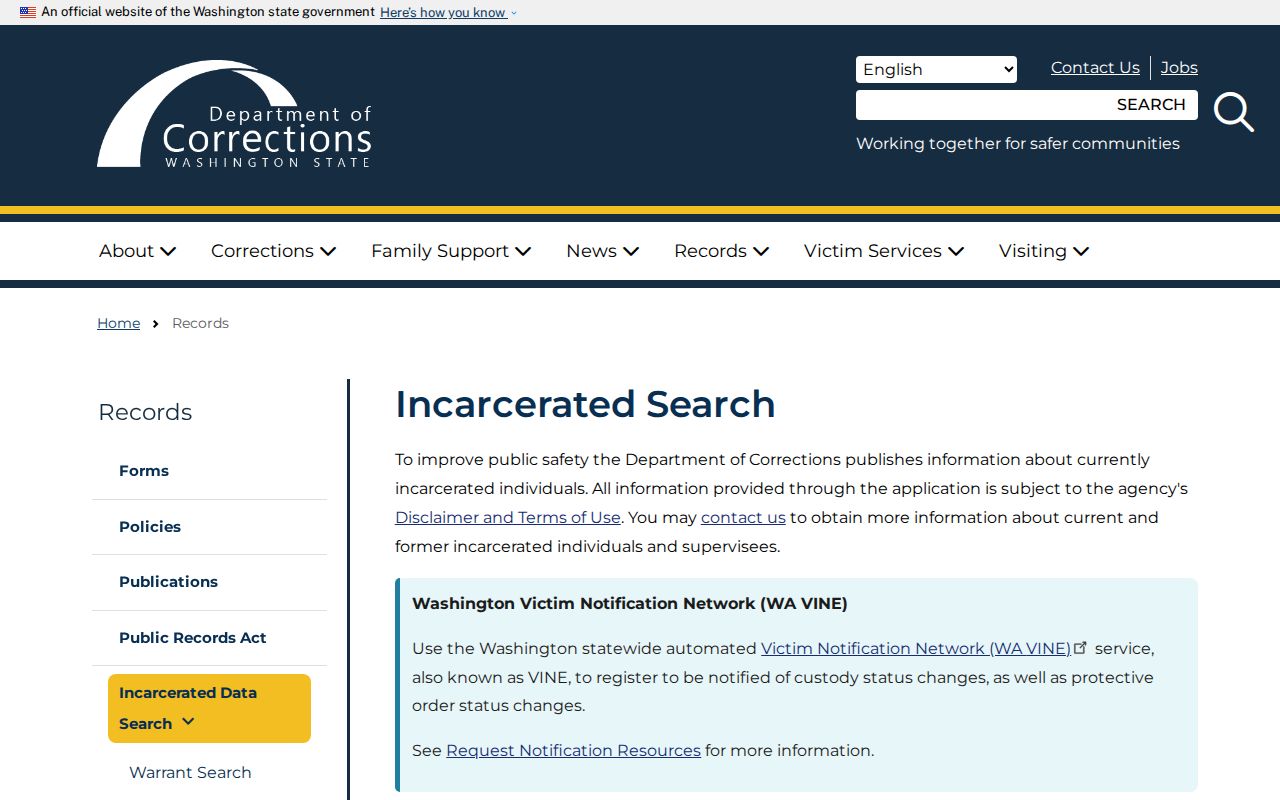
The incarcerated-search page takes a name or DOC number and returns custody fields. It is not the community-custody warrant tool.
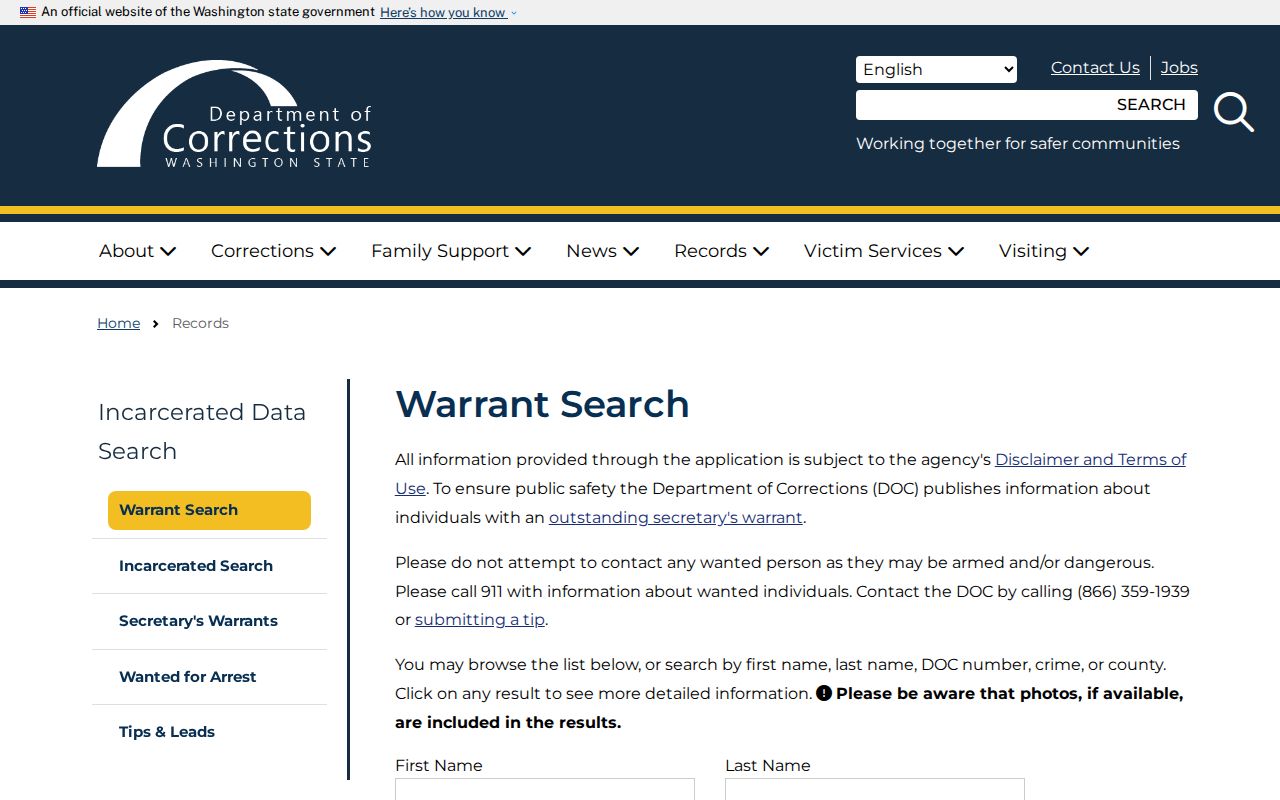
That photo note applies to this tool alone. Rely on the live result and DOC's own explanation instead of assuming every record carries an image.
How to Check a Washington Warrant
There is no universal statewide warrant screen, so a careful check follows the record to its issuing authority. A name-only search can return people with similar names or miss a record because of spelling, date, or system coverage. Use identifying details only on official services and handle them privately. Do not publish another person's personal information in an attempt to confirm a match.
- Identify the likely jurisdiction. Use the county and court connected to the arrest, citation, supervision, or case. A warrant may be municipal, district, superior court, or agency-based.
- Search the court's official case index. Washington Courts provides a statewide name-and-case search, and participating superior courts use the Odyssey Portal. Coverage differs; King and Pierce also maintain separate court tools.
- Check DOC only for a DOC matter. Use the Secretary's Warrant Search for an alleged community-custody violation warrant. Read the DOC page's explanation and don't treat the ordinary incarcerated search as a warrant result.
- Ask the issuing court or agency to confirm. A public index can lag or omit documents. Contact the clerk or agency named in the record, using a number published on its official website.
- Get legal guidance when the result concerns you. If you believe a warrant may be active in your name, contact a lawyer or the court for instructions. Do not rely on a third-party lookup or try to resolve it by approaching an officer in an unsafe setting.
The Washington Courts name and case search guidance says the statewide index updates daily, around 3 a.m. It serves as reference only, not the official record. Not every document appears there. The Odyssey Portal covers participating superior courts. King County Superior Court and Pierce County LINX keep separate access points. Sealed matters, juvenile records, and restricted documents stay hidden from an open docket view.
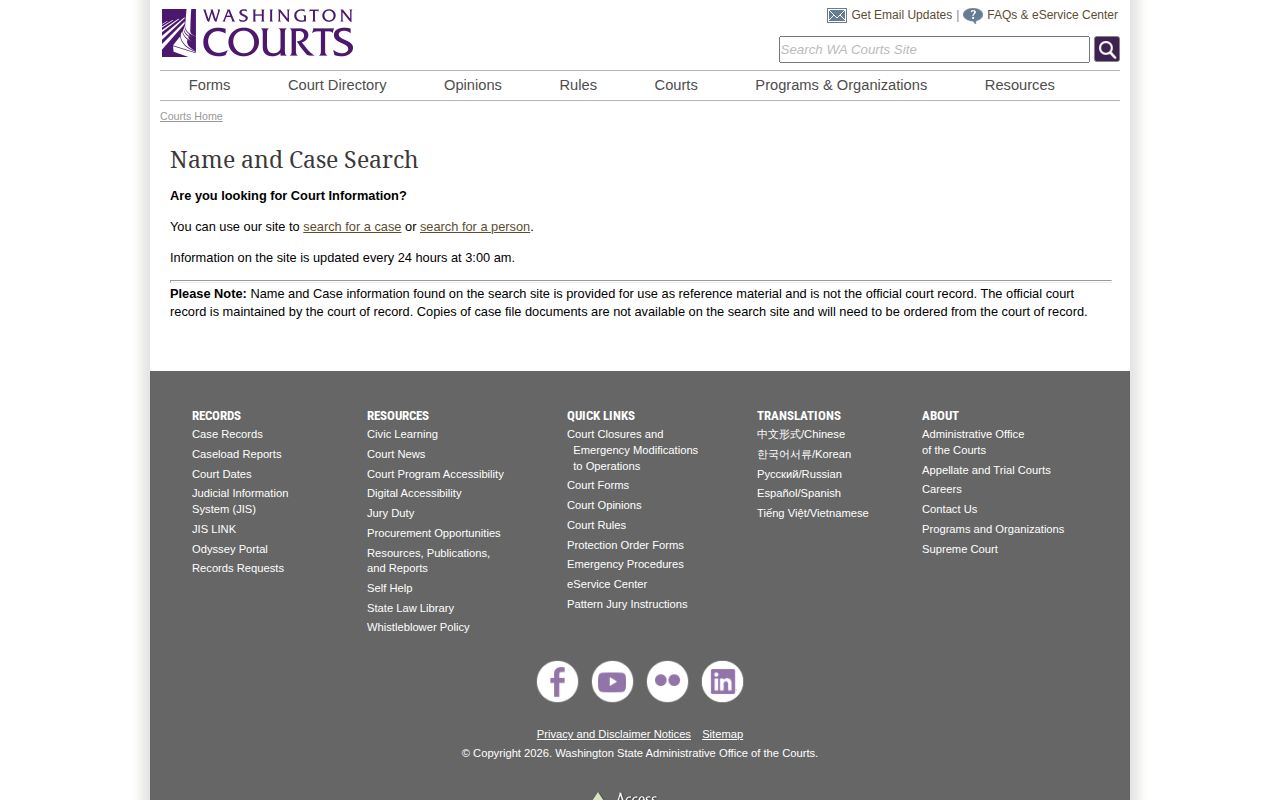
Verify disposition with the court of record. Verify warrant status with the issuing agency. A charge, a warrant, a conviction, a sentence, and a release are all separate events in the life of a case.
What a Wanted Listing Can Show
Fields vary by listing. Treat each one as information the issuing agency supplied, not as independent proof.
| Field | What it may mean | What to verify |
|---|---|---|
| Name and aliases | Names associated with the agency record. | Do not identify someone by name alone. |
| Photo or physical description | An image or identifying information selected for that notice. | Check the live page and date; lookalikes and outdated photos are possible. |
| Warrant or case detail | The issuing office, alleged violation, or case identifier. | Ask that office whether the matter remains active. |
| Location or last-known information | Information the agency chose to publish at a point in time. | Do not use it to follow or confront anyone. |
| Tip instructions | The agency's requested channel for information. | Use only contact details on the official page. |
A wanted listing is a request for help, not a courtroom outcome. Treat it as a warrant notice or an investigative step. When a later source says the person was arrested or the case closed, confirm it with the court or agency before you repeat the update. An undated copy of a name, photo, or charge deserves no audience.
Common Warrant Search Paths
The right system depends on who issued the warrant. Status confirmation belongs to the agency that issued it, not to any list.
| Record type | Starting point | Limit |
|---|---|---|
| DOC Secretary's warrant | DOC Secretary's Warrant Search and its background page. | Relates to DOC community custody and the agency's stated publication criteria. |
| State or local court warrant | Relevant court's case index, clerk, or issuing law-enforcement office. | Indexes vary by court and may not provide live warrant status. |
| Federal fugitive notice | USMS or the federal agency named in the notice. | Public wanted pages are selected notices, not a national warrant register. |
| Local law-enforcement notice | Official sheriff or police page for the responsible agency. | Local coverage is not a countywide or statewide completeness claim. |
Start with who issued the warrant. DOC says a Secretary's warrant can involve a community-custody violation. One open more than 60 days may be listed publicly. The warrant background page also covers indefinite warrants. These apply to people released to ICE before finishing their terms. Those are DOC rules, not a general deadline for other warrant types. Read any result beside the agency's own explanation. Federal custody and immigration systems answer different questions from a state wanted notice. That notice names the right agency to confirm status.
Confirm Status Before You Act
A public listing can point you to the right agency. That is its real value. Status, though, belongs with the record holder. The statewide courts index refreshes on its own schedule and is meant for reference only. A court file may hold the controlling order. The issuing law-enforcement agency can tell you whether a recall, service, or other update has come in. Ask each source what it covers and when it was last refreshed.
Searching your own case? Write down the court name, case number, and date shown. Then use the clerk's official contact route. Records under a similar name may not be yours, so never assume a match. Sealed and juvenile matters carry extra access limits. Silence from a source proves nothing either, since coverage and search rules vary widely.
For general arrest information, skip the wanted notice. Start with the arresting agency's official register. Then follow the case all the way to the right court. The Washington busted-mugshots guide spans several sources. It shows how county jail registers, DOC searches, and court records each answer different questions. Keep booking, charge, warrant, and conviction status separate. Do the same for supervision and release status in anything you write or share.
Most importantly, leave investigation to law enforcement. Never approach, follow, message, threaten, or detain someone because of a listing. Publishing a private address is off limits too. If a person seems immediately dangerous, get to safety and call 911. For anything else, use the official tip channel the responsible agency names.